




A trade record only shows what was agreed: price, size, counterparty and when. It doesn't show who else responded, how fast, or who didn't answer at all. It doesn't show the prices that were better but too slow, or the ones that weren't good enough to matter. That history does exist. It's just sitting in chat, spread across every RFQ a desk has ever sent, and until now there's been no cost-efficient way to pull it out and turn it into something usable.
One quote doesn't show you the pattern
A single RFQ response or axe is one data point: a bid, an offer, a fill or a no-fill. On its own, it provides almost no information about best bids, best offers, who responds and who doesn't, or average response times. None of that comes from any one quote - it comes from looking at all of them together, and the pattern only appears once you aggregate responses.
Analytics turns that history into something you can act on before you go to the market
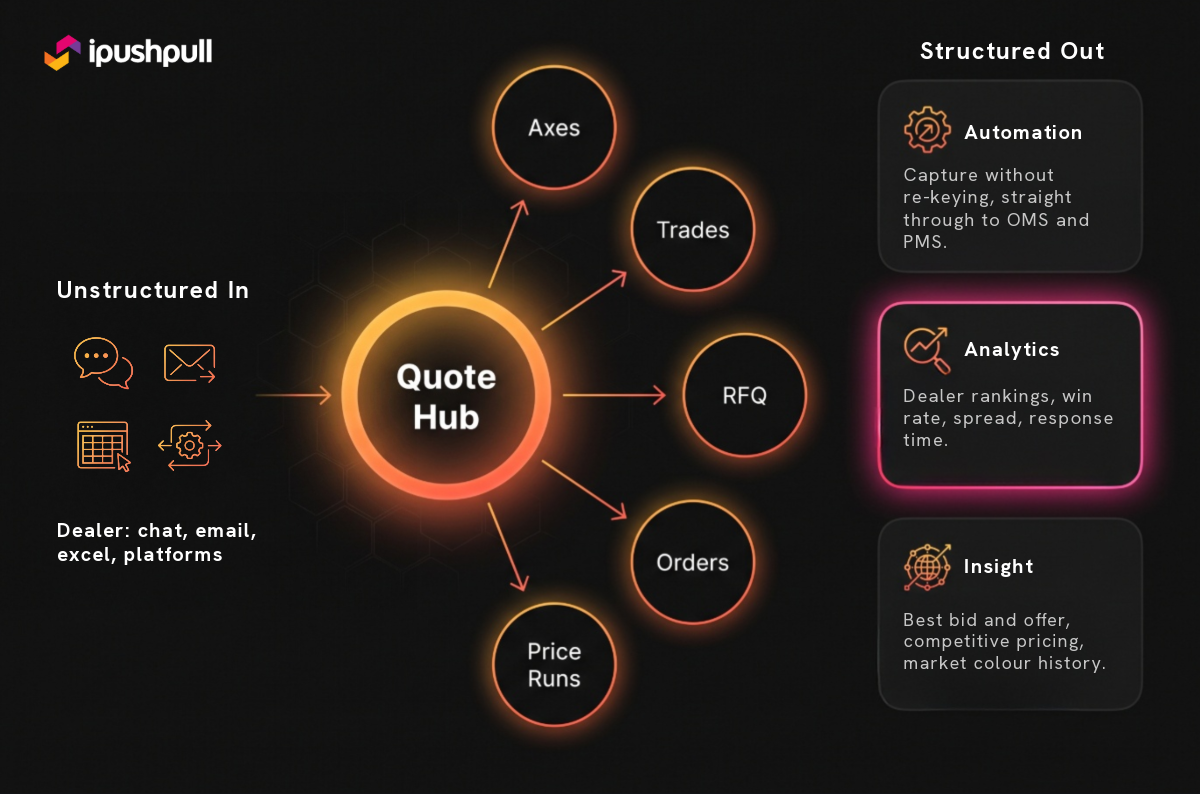
That full pricing history, across dealers, brokers, clients and counterparties, covering what was priced and not just what traded, is powerful information and it's made available and can be visualised and analysed in Quote Hub. It surfaces who's the best to reach out to, and it automates that outreach workflow.
Before sending an RFQ, the desk can run a what-if analysis against that history to select the best recipients based on real data, focusing only on those most likely to respond in a timely way with the best prices.
How this makes finding the best price more efficient
Seeing the pattern before sending an RFQ changes the starting point. Working from a fixed list of targets on gut feel or habit is less focused and will, on average, result in worse pricing than a selective outreach to counterparties based on history and analytics.
A more selective approach also changes who sees interest. Sending an RFQ to a narrower, better-informed field of targets means fewer see the position being worked so that less of the strategy leaks out to the market.
This is pricing data first, market intelligence next
Analytics today is pricing context: what was quoted, by whom and how fast. The next step is aggregating the chat itself into something broader: market sentiment, news and checking whether what a counterparty says in conversation matches how they price.
A trader working off a single quote is negotiating on less information than one working off the whole pattern, and that gap widens as more of the desk's conversations get structured.
Learn more about Quote Hub from ipushpull.